
You are using an out of date browser. It may not display this or other websites correctly.
You should upgrade or use an alternative browser.
You should upgrade or use an alternative browser.
C&C condundrum i dont get
- Thread starter Belfadin
- Start date



Mikatelyn
Junior Guinea Pig
Good visual rp1993!
To take it to the extreme, if you did a cage that was 0 grids by 6 grids, you would just have a flat line of grids, but with no space in between. It would still take 12 grids, but you would have no square footage.
0x6 =0
To take it to the extreme, if you did a cage that was 0 grids by 6 grids, you would just have a flat line of grids, but with no space in between. It would still take 12 grids, but you would have no square footage.
0x6 =0


I love maths problems, and this one is actually quite famous 
To simplify it we are actually talking about two totally different things, which is why they don't match up.
The area is the number of squares (they can be any size - inches, cm, meters, etc) that fit inside a given area (our C&C cage).
The perimeter is the number of lines (they can be any size - inches, cm, meters, etc) that go around the outside of a shape (our C&C grids).
Area and perimeter are not proportionally related - in simple terms a bigger permitter doesn't always mean more space inside the shape.
If you want a more detailed explanation Google 'Isoperimetric Problem' but probably only do this if you are a bit of a maths geek .
.
A more simple way to visualise it would be to take a piece of string and knot the two end together. Move the string into different shapes and see which shape gives you the most space inside (spoiler - it's a circle). The length of the string (perimeter) doesn't change, but the space inside does, depending on how you position it.
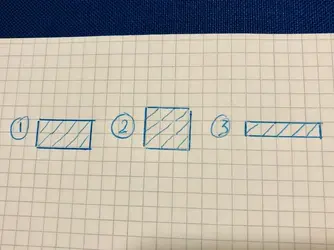
With 12 C&C grids you have 3 simple cage arrangements.
All use the same number of grids (perimeter) but all offer different amount of space inside (area).
1. 2x4 C&C has 8 squares inside
2. 3x3 C&C has 9 squares inside
3. 1x5 C&C has 5 squares inside
Lesson over
To simplify it we are actually talking about two totally different things, which is why they don't match up.
The area is the number of squares (they can be any size - inches, cm, meters, etc) that fit inside a given area (our C&C cage).
The perimeter is the number of lines (they can be any size - inches, cm, meters, etc) that go around the outside of a shape (our C&C grids).
Area and perimeter are not proportionally related - in simple terms a bigger permitter doesn't always mean more space inside the shape.
If you want a more detailed explanation Google 'Isoperimetric Problem' but probably only do this if you are a bit of a maths geek
.A more simple way to visualise it would be to take a piece of string and knot the two end together. Move the string into different shapes and see which shape gives you the most space inside (spoiler - it's a circle). The length of the string (perimeter) doesn't change, but the space inside does, depending on how you position it.
With 12 C&C grids you have 3 simple cage arrangements.
All use the same number of grids (perimeter) but all offer different amount of space inside (area).
1. 2x4 C&C has 8 squares inside
2. 3x3 C&C has 9 squares inside
3. 1x5 C&C has 5 squares inside
Lesson over
Last edited by a moderator:

PigglePuggle
Senior Guinea Pig
Very comprehensive answer @Swissgreys I was thinking that perimeter and area arent directly proportional but my biologist brain could only come up with an answer based on flatworms having more surface area than cylindrical worms of the same size, which is why flatworms dont need gills or blood, they are all surface not much volume for soaking things upI love maths problems, and this one is actually quite famous
To simplify it we are actually talking about two totally different things, which is why they don't match up.
The area is the number of squares (they can be any size - inches, cm, meters, etc) that fit inside a given area (our C&C cage).
The perimeter is the number of lines (they can be any size - inches, cm, meters, etc) that go around the outside of a shape (our C&C grids).
Area and perimeter are not proportionally related - in simple terms a bigger permitter doesn't always mean more space inside the shape.
If you want a more detailed explanation Google 'Isoperimetric Problem' but probably only do this if you are a bit of a maths geek
A more simple way to visualise it would be to take a piece of string and knot the two end together. Move the string into different shapes and see which shape gives you the most space inside (spoiler - it's a circle). The length of the string (perimeter) doesn't change, but the space inside does, depending on how you position it.
With 12 C&C grids you have 3 simple cage arrangements.
All use the same number of grids (perimeter) but all offer different amount of space inside (area).
1. 2x4 C&C has 8 squares inside
2. 3x3 C&C has 9 squares inside
3. 2x5 C&C has 5 squares inside
View attachment 157680
Lesson over
 I think you explained it better
Spaghetti & Noodles
Forum Donator 2026/27
Every day is a school day!

2ft x4ft =8sq ft
3ft x 3 ft =9 sq ft
You are using the same number of grids, but the longer, flatter rectangle has less square footage than a square if the length of the perimeter is the same.
When talking about c&c cages we talk in numbers of grids not measurements. So a 2x4 c&c is not 2ft x4ft, it actually measures 2ft x 5ft due to the size of the grids.
a 3x3 c&c cage is not 3ft x 3ft, it’s slightly larger than that as 3 c&c grids measures 112cm not 90cm

Zanzan
Adult Guinea Pig
Wow I have honestly learnt something new today....the same perimeter doesn't necessarily give you the same area. I really never knew this. Thanks everyone!
(There's a reason I teach cooking not maths.....)
(There's a reason I teach cooking not maths.....)

2x4 is 12 grids, 3x3 i 12 grids yet 3x3 is more square foot, how is this possible with same grids and a shape made?
2x4 = 8 units square
3x3 = 9 units square
Although the circumference is the same, the space that is enclosed is not.
When you lay it out and cover the cage floor with fabric, you will immediately notice that there really is a difference in the cage size. You need fleece for a 3x3 cage compared to a 2x4.
The closer you can come to a circle in terms of circumference, the more space you can enclose; the circle is the optimum ratio of the shortest rim to maximum enclosed space. The more irregular the circumference and the further removed the cage shape is from a circle, the more rim/grids you'll need and the less inside space you get. Geometrics...
@Swissgreys has demonstrated that perfectly - the narrower and longer a cage, the less inside space you get for the number of grids. A square grid cage is the best way of achieving maximum inside space with a minimum of C&C grids.
But there are always practical aspects with a cage layout, too - you can usually reach with your arms across a 2 grid space but you can't do that with a wider cage; so if you have an elevated C&C cage or an upper story, it can only be so wide or you either have to crawl to clean underneath or need steps to reach across. A longer and narrower cage is easier to clean and maintain without having to step into the cage.

Siikibam
Senior Guinea Pig
I’ve added isoperimetric problem to my reading listI love maths problems, and this one is actually quite famous
To simplify it we are actually talking about two totally different things, which is why they don't match up.
The area is the number of squares (they can be any size - inches, cm, meters, etc) that fit inside a given area (our C&C cage).
The perimeter is the number of lines (they can be any size - inches, cm, meters, etc) that go around the outside of a shape (our C&C grids).
Area and perimeter are not proportionally related - in simple terms a bigger permitter doesn't always mean more space inside the shape.
If you want a more detailed explanation Google 'Isoperimetric Problem' but probably only do this if you are a bit of a maths geek
A more simple way to visualise it would be to take a piece of string and knot the two end together. Move the string into different shapes and see which shape gives you the most space inside (spoiler - it's a circle). The length of the string (perimeter) doesn't change, but the space inside does, depending on how you position it.
With 12 C&C grids you have 3 simple cage arrangements.
All use the same number of grids (perimeter) but all offer different amount of space inside (area).
1. 2x4 C&C has 8 squares inside
2. 3x3 C&C has 9 squares inside
3. 1x5 C&C has 5 squares inside
View attachment 157680
Lesson over


Betsy
Anniversary Herd
I love maths problems, and this one is actually quite famous
To simplify it we are actually talking about two totally different things, which is why they don't match up.
The area is the number of squares (they can be any size - inches, cm, meters, etc) that fit inside a given area (our C&C cage).
The perimeter is the number of lines (they can be any size - inches, cm, meters, etc) that go around the outside of a shape (our C&C grids).
Area and perimeter are not proportionally related - in simple terms a bigger permitter doesn't always mean more space inside the shape.
If you want a more detailed explanation Google 'Isoperimetric Problem' but probably only do this if you are a bit of a maths geek
A more simple way to visualise it would be to take a piece of string and knot the two end together. Move the string into different shapes and see which shape gives you the most space inside (spoiler - it's a circle). The length of the string (perimeter) doesn't change, but the space inside does, depending on how you position it.
With 12 C&C grids you have 3 simple cage arrangements.
All use the same number of grids (perimeter) but all offer different amount of space inside (area).
1. 2x4 C&C has 8 squares inside
2. 3x3 C&C has 9 squares inside
3. 1x5 C&C has 5 squares inside
View attachment 157680
Lesson over
Wha?!?!? This is clearly why I never passed my Maths O Level. I hardly understood a word of that brilliant explanation!
I think I prefer @PigglePuggle's
Very comprehensive answer @Swissgreys I was thinking that perimeter and area arent directly proportional but my biologist brain could only come up with an answer based on flatworms having more surface area than cylindrical worms of the same size, which is why flatworms dont need gills or blood, they are all surface not much volume for soaking things up
PigglePuggle
Senior Guinea Pig
I can add a cooking example too! Flat biscuits cook faster that a round bun made with the same amount of mixture. Because the bun has more inside than outside, and the biscuit has more outside than insideWha?!?!? This is clearly why I never passed my Maths O Level. I hardly understood a word of that brilliant explanation!
I think I prefer @PigglePuggle's
Betsy
Anniversary Herd
Thanks I understand that one perfectly having baked biscuits and cakes for a very long time!I can add a cooking example too! Flat biscuits cook faster that a round bun made with the same amount of mixture. Because the bun has more inside than outside, and the biscuit has more outside than inside
Now I want a biscuitThanks I understand that one perfectly having baked biscuits and cakes for a very long time!


Qualcast&Flymo
Forum Donator 2025/26
- Joined
- Jun 7, 2017
- Messages
- 6,202
- Reaction score
- 14,083
- Points
- 1,925
- Location
- Solihull, West Midlands
This all reminds me of my utter failure when I was trying to help some year 6 kids at my son's school with their geometry. They had to work out the area of a parallelogram, I couldn't remember the formula and thought it ought to be the same as a rectangle with the same length sides.
Very stupid and not very helpful for the kids, as of course if you if you squashed a rectangle all the way, you would end up with a straight line with no area at all ....
Very stupid and not very helpful for the kids, as of course if you if you squashed a rectangle all the way, you would end up with a straight line with no area at all ....
PigglePuggle
Senior Guinea Pig
So do I, just been chatting/hoping with my daughter that after lockdown ends we can have our usual pre-xmas tree putting up party on the first weekend in december and make Christmas gingerbread biscuits and mince piesNow I want a biscuit
my daughter failed maths (she's a sociology type so not surprising!) but she's an excellent cook and hosts brilliant family parties
Betsy
Anniversary Herd
I'll be making mince pies in December. It all depends when I think my homemade mincemeat will be mature enough which I made in May it takes at least 6 months to mature. It's better if you make it 18 months before you want to use it but last year was a bit hectic for me.
PigglePuggle
Senior Guinea Pig
I'll have shop bought mince pie filling but next week I will be making some of my special Christmassy fig and balsamic vinegar chutney, I make it every year for piggy daddy's birthday then put it in kilner jars to keep until Christmas! When its fresh made we have it hot as a topping on roast butternut squash, served with a melty bit of goat's cheese or stilton for piggy daddy for his birthday dinnerI'll be making mince pies in December. It all depends when I think my homemade mincemeat will be mature enough which I made in May it takes at least 6 months to mature. It's better if you make it 18 months before you want to use it but last year was a bit hectic for me.
look at us derailing a maths problem thread with Christmas cookery
Betsy
Anniversary Herd
You started the derailing with talk of buns and biscuits! I just carried the theme on! Well cooking is Maths and Science anyway.I'll have shop bought mince pie filling but next week I will be making some of my special Christmassy fig and balsamic vinegar chutney, I make it every year for piggy daddy's birthday then put it in kilner jars to keep until Christmas! When its fresh made we have it hot as a topping on roast butternut squash, served with a melty bit of goat's cheese or stilton for piggy daddy for his birthday dinner

Eddie & Elvis
Adult Guinea Pig
I'm definitely not a maths person so I'll happily stay on the topic of biscuits
Eddie & Elvis
Adult Guinea Pig
This is very interesting/ confusing though, how can the flat worm have more surface area if they're the same size?Very comprehensive answer @Swissgreys I was thinking that perimeter and area arent directly proportional but my biologist brain could only come up with an answer based on flatworms having more surface area than cylindrical worms of the same size, which is why flatworms dont need gills or blood, they are all surface not much volume for soaking things up
PigglePuggle
Senior Guinea Pig
Cos they flat like biscuits not round like bunsThis is very interesting/ confusing though, how can the flat worm have more surface area if they're the same size?
can we now move on to the geometrical properties of pies? I really fancy a pie... just realised I forgot to make dinner so its either couscous or noodles which have very little in the way of culinary or geospatial sophistication 
Qualcast&Flymo
Forum Donator 2025/26
- Joined
- Jun 7, 2017
- Messages
- 6,202
- Reaction score
- 14,083
- Points
- 1,925
- Location
- Solihull, West Midlands
You could have noodles and have fun pretending to be an Ood - "I shall sing you the song of my people..."
Betsy
Anniversary Herd
On the subject of pies I made a lovely cauliflower cheese cottage pie on Monday!Cos they flat like biscuits not round like buns
Share: