• Discussions taking place within this forum are intended for the purpose of assisting you in discussing options with your vet. Any other use of advice given here is done so at your risk, is solely your responsibility and not that of this forum or its owner. Before posting it is your responsibility you abide by this Statement

Guinea Pig Squealing While Pooping/peeing

Status
Not open for further replies.

Treppenwitz

Junior Guinea Pig
Joined
Jun 6, 2017
Messages
11
Reaction score
3
Points
50
Location
Uruguay
Hi, I'm new over here and excuse me if it's hard to understand me because english is not my mother language. I have a cute female guinea pig which is about 2 and a half years old. For the last 50 days she has been showing different health problems, first she started with anorexia, then diarrhea and now she screams pretty loud while pooping AND peeing. We've already seen 3 different (exotic pets) vets. She also had an ultrasound where they found nothing abnormal and no kidney stones. She started eating less and less, because of the pain, now we're hand feeding her. We started treating her with Bacticel (cotrimoxazole) yesterday, the vet thinks that it's not urinary infection because there's no blood whatsoever in the pee, but we're treating her anyway just to discard that possibility. She's also taking an urinary analgesic, I don't know the name but is 1/16 of a pill that dissolves as an strong orange liquid.

Has anyone had a similar experience? Do you have any advice? Thanks a lot, the vet says that she's running out of alternatives.
 
Hi, I'm new over here and excuse me if it's hard to understand me because english is not my mother language. I have a cute female guinea pig which is about 2 and a half years old. For the last 50 days she has been showing different health problems, first she started with anorexia, then diarrhea and now she screams pretty loud while pooping AND peeing. We've already seen 3 different (exotic pets) vets. She also had an ultrasound where they found nothing abnormal and no kidney stones. She started eating less and less, because of the pain, now we're hand feeding her. We started treating her with Bacticel (cotrimoxazole) yesterday, the vet thinks that it's not urinary infection because there's no blood whatsoever in the pee, but we're treating her anyway just to discard that possibility. She's also taking an urinary analgesic, I don't know the name but is 1/16 of a pill that dissolves as an strong orange liquid.

Has anyone had a similar experience? Do you have any advice? Thanks a lot, the vet says that she's running out of alternatives.

To be honest, it doesn't sound like interstitial cystitis. The pain/problem that is causing the symptoms may not be located in the urinary tract, but it can sit in the digestive system, in the reproductive tract (uterus, ovarian cysts) or the body cavy and is pressing on the guts and the urinary tract.

Have your vets looked at IC (interstitial cystitis), which usually has traces of blood in the urine?

I am tagging some more experienced members into your thread:
@helen105281 @Freela @Jaycey

Could you please add your country to your details, so we can adjust any advice to make it easier for you and your vet to find a local brand or read up on it if necessary etc. Please click on your username on the top bar, then go to personal details and scroll down to location. This makes it appear underneath your avatar picture and your username in every post you make and allows us to tailor any recommendations straight away. From your choice of username I assume that you are a German speaker? Thank you!
 
I'm actually spanish speaker, from south america. They checked the uterus and intestine during the ultrasound, they even checked the heart (I believe just because they were already checking). We didn't find any kind of blood on the urine. The poop comes watery and in lumps now and then, the vet believes that this is because she mostly eats her favorite food (lettuce). We have tried to take away lettuce from her diet, but she is eating very little and lettuce is the only food that somehow motivates her to eat. She also eats a small portions of hay, pellets, fresh corn husk, carrot and peppers (mostly green). But her favorite by far is the lettuce, sometime she screams when she hears us opening the fridge just asking for lettuce.
 
Hi, of course I cannot help you although I had a similar experience long ago with another piggie 2 years old... I hope it is an infection somewhere, so that your piggie can recover with the treatment. Anyway, a cystitis not necessary has blood and if there is blood, sometimes it is not visible, but appears only at the lab test. When it happened to me I had to collect the wee of the pig and take it to the lab; the wee appeared clear but the result was horrific. And it was too late... because my piggie stopped eating and I could not syringe him forever.
An infection into kidneys (pielonefrite is the italian name) does cause a huge pain also in the butt and when you try to poo. But there could be different causes of those symptoms...
I don't think you are italian, therefore I cannot help you with some names of famous "gods" vets specialised in guinea pigs...
 
Hi, of course I cannot help you although I had a similar experience long ago with another piggie 2 years old... I hope it is an infection somewhere, so that your piggie can recover with the treatment. Anyway, a cystitis not necessary has blood and if there is blood, sometimes it is not visible, but appears only at the lab test. When it happened to me I had to collect the wee of the pig and take it to the lab; the wee appeared clear but the result was horrific. And it was too late... because my piggie stopped eating and I could not syringe him forever.
An infection into kidneys (pielonefrite is the italian name) does cause a huge pain also in the butt and when you try to poo. But there could be different causes of those symptoms...
I don't think you are italian, therefore I cannot help you with some names of famous "gods" vets specialised in guinea pigs...
Thanks, I'm sorry to hear your experience and the outcome. The vet said we could try to take an urine sample just to check for the ph (and that taking the sample without poop or another kind of contamination would be hard), and that that information could confirm an urinary infection. I don't know if bacticel works for kidney problems but I hope so.
 
she is so cute.. I hope she can recover... But looking at the pic, maybe it is an effect of the light: what are those white spots on her fur? maybe just a little bit of dust? does she like fresh grass? lettuce is rich of nitrates and poor of vitamins... piggies usually love the common "string" grass which has a better nutritional value
 
she is so cute.. I hope she can recover... But looking at the pic, maybe it is an effect of the light: what are those white spots on her fur? maybe just a little bit of dust? does she like fresh grass? lettuce is rich of nitrates and poor of vitamins... piggies usually love the common "string" grass which has a better nutritional value
She does like grass but it's hard for me to come by because I live in an apartment and there's no available grass where I know from sure that is not treated with any kind of chemicals/pesticides. Anyway, the vet said that I could try to get some from anywhere as long as I wash it throughly.
 
I'm actually spanish speaker, from south america. They checked the uterus and intestine during the ultrasound, they even checked the heart (I believe just because they were already checking). We didn't find any kind of blood on the urine. The poop comes watery and in lumps now and then, the vet believes that this is because she mostly eats her favorite food (lettuce). We have tried to take away lettuce from her diet, but she is eating very little and lettuce is the only food that somehow motivates her to eat. She also eats a small portions of hay, pellets, fresh corn husk, carrot and peppers (mostly green). But her favorite by far is the lettuce, sometime she screams when she hears us opening the fridge just asking for lettuce.

Hi! her diarrhea is most likely caused by not eating enough fibre. Up to 80% of the daily food intake is actually hay, which is usually the first food group that is being dropped and which you cannot control. Vegetables should make only about 5-10% of the daily food intake.
Please weigh her daily at the same time and start syringe feeding asap. You may find that with more fibrous food in her guts, some of the symptoms will disappear.

Here is our illustrated syringe feeding guide. In an emergency you can use mushed up pellets instead of a recovery formula (powder, which you mix with water), but we have included recovery food brand names that are available in many countries. In most cases, you need to prepare the syringe tip to allow the fibre to pass through. You can find the picture guide for that as well as tips on how much/how often to feed. In order to control the food intake, you need to weigh your girl daily at the same time. ordinary kitchen scales will do.
Complete Syringe Feeding Guide
Recommendations For A Balanced General Guinea Pig Diet

Have your vets done a fecal test to see whether the problem is located in the guts (worms and other nasty bugs)?
 
Thanks, I'm sorry to hear your experience and the outcome. The vet said we could try to take an urine sample just to check for the ph (and that taking the sample without poop or another kind of contamination would be hard), and that that information could confirm an urinary infection. I don't know if bacticel works for kidney problems but I hope so.
If bacteria come from the outside the lab is able to distinguish. In fact that day I collected the wee from the floor and the problem was not the bacterfia, but the nitrates and other stuff related to an infection. Anyway, such test is possibole only before starting the antibiotics, therefore now you just have to wait and if the infection is somewhere it will work. I think you have caught it in time... with my piggie things went on differently, anyway his bad style of eating damaged his inner body, therefore the infection was not the main problem...
Chemical and pesticides? lettuce is FILLED with chemical products... here vets (and doctors) say it is safer to eat the grass growing around the Colusseum that the lettuce from supermarkets :)) and I agree, considering the foam and the colour I see into the water I use for washing the lettuce...
I also live in a city, in a flat, but I have found some private areas and large parks where grass is available. you could produce some grass, the one for cats is appreciated, too :)
 
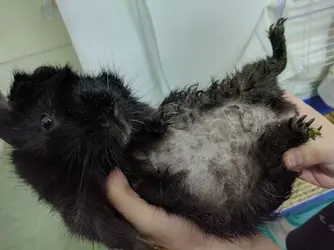
Here's a picture of her after shaving her belly for the ultrasound (which she REALLY disliked).

View attachment 64649

The skin looks like it could have fungal bloom in your picture? However, this would be only a secondary issue, caused by a weakening immune system and not the root of your main problem. A mild fungal shampoo should do the trick if your vet diagnoses a fungal skin infection.
 
Hi! her diarrhea is most likely caused by not eating enough fibre. Up to 80% of the daily food intake is actually hay, which is usually the first food group that is being dropped and which you cannot control. Vegetables should make only about 5-10% of the daily food intake.
Please weigh her daily at the same time and start syringe feeding asap. You may find that with more fibrous food in her guts, some of the symptoms will disappear.

Here is our illustrated syringe feeding guide. In an emergency you can use mushed up pellets instead of a recovery formula (powder, which you mix with water), but we have included recovery food brand names that are available in many countries. In most cases, you need to prepare the syringe tip to allow the fibre to pass through. You can find the picture guide for that as well as tips on how much/how often to feed. In order to control the food intake, you need to weigh your girl daily at the same time. ordinary kitchen scales will do.
Complete Syringe Feeding Guide
Recommendations For A Balanced General Guinea Pig Diet

Have your vets done a fecal test to see whether the problem is located in the guts (worms and other nasty bugs)?


Yes, we had to hand feed her when the illness began (first symptom was complete anorexia, for about 7 days). We have been weighing her since then, at first she plateaued at 690 gr (which is a pretty low weight for her) and now she lost around 60 extra grams. We are now hand feeding her a mix of corn husk/pepper/lettuce but I will go through your guide looking for advice on how to do it better. They made a fecal test which came negative (they said that false negatives are more common than false positives).
 
If bacteria come from the outside the lab is able to distinguish. In fact that day I collected the wee from the floor and the problem was not the bacterfia, but the nitrates and other stuff related to an infection. Anyway, such test is possibole only before starting the antibiotics, therefore now you just have to wait and if the infection is somewhere it will work. I think you have caught it in time... with my piggie things went on differently, anyway his bad style of eating damaged his inner body, therefore the infection was not the main problem...
Chemical and pesticides? lettuce is FILLED with chemical products... here vets (and doctors) say it is safer to eat the grass growing around the Colusseum that the lettuce from supermarkets :)) and I agree, considering the foam and the colour I see into the water I use for washing the lettuce...
I also live in a city, in a flat, but I have found some private areas and large parks where grass is available. you could produce some grass, the one for cats is appreciated, too :)
Yes, I'll actively look into it, thanks for the advice!
 
As @Wiebke says, fibre is the main rule. Hay is their first food, but if they are lazy and weak for eating a HUGE amount of hay, you can cut some grass, not the soft one, but the real grass. Now it is not time to think about pollution on the grass (and also Rome is full of green clean areas), but to make her gut recover; diarrhea is dangerous and make things worse...
If I were you I would not use a mix of vegs for syringe feeding her, I would use Critical Care by Oxbow. I am against industrial food as a normal meal, but in certain situation it is necessary.
 
As @Wiebke says, fibre is the main rule. Hay is their first food, but if they are lazy and weak for eating a HUGE amount of hay, you can cut some grass, not the soft one, but the real grass. Now it is not time to think about pollution on the grass (and also Rome is full of green clean areas), but to make her gut recover; diarrhea is dangerous and make things worse...
If I were you I would not use a mix of vegs for syringe feeding her, I would use Critical Care by Oxbow. I am against industrial food as a normal meal, but in certain situation it is necessary.
I don't believe that that kind of formula is available here as none of the 3 vets we've seen recommended it or mentioned it as an option, I'll ask the next time I talk to her but my expectations are pretty low.
 
I don't believe that that kind of formula is available here as none of the 3 vets we've seen recommended it or mentioned it as an option, I'll ask the next time I talk to her but my expectations are pretty low.

You may be able to order Oxbow critical care online and find a supplier in your country. If you have the choice, go for the fine grind; it is much easier to feed and most guinea pigs like it better.

Many vets (even exotics!) are just not aware how vital a regular fibrous food intake is for guinea pigs, and how important it is to syringe feed as soon as you notice changes in appetite/loss of weight. This is however not going to solve the problem, but it is hopefully giving you a chance to keep your girl alive until you can get to the bottom of your problems.
 
vets and doctors sometimes (often?), also the "exotic" and the "specialists" know nothing about nutrition. Believe me...
 
My initial thought is a digestive issue. How much does she weigh? Is her weight stable or is it going down?

One of my boys has a digestive issue. If I feed him certain veg, like dill or tomato his poops change and he will squeal when peeing and pooping.

We have to monitor him closely and not feed him anything that upsets his stomach.

Have you done this for your pig? Sometimes once they have a digestive issue they can never go back to eating the same food as it will upset them.

Try grass as @rome_italy suggests. I live in a house with a tiny concrete garden so I grow grass in trays for them. You can even grow it indoors.

My boy with the digestive issue recently had a test done on his poop and it came back that he had a fungal issue. So we are currently trying a medicine called Itrafungal.
 
My initial thought is a digestive issue. How much does she weigh? Is her weight stable or is it going down?

One of my boys has a digestive issue. If I feed him certain veg, like dill or tomato his poops change and he will squeal when peeing and pooping.

We have to monitor him closely and not feed him anything that upsets his stomach.

Have you done this for your pig? Sometimes once they have a digestive issue they can never go back to eating the same food as it will upset them.

Try grass as @rome_italy suggests. I live in a house with a tiny concrete garden so I grow grass in trays for them. You can even grow it indoors.

My boy with the digestive issue recently had a test done on his poop and it came back that he had a fungal issue. So we are currently trying a medicine called Itrafungal.
Her diet is pretty limited right now, I can try to limit it further to something like "only corn husks, hay and pellets" and see if that shows some kind of improvement. I'll also check with my vet if we can check for fungal issues. Thanks for your response.
 
@Treppenwitz Good luck. I've been very lucky with my boy but I have heard of some that have had to reduce what they could eat right down, and then slowly introduce things back on at a time to see what was causing the problem.
 
My initial thought is a digestive issue. How much does she weigh? Is her weight stable or is it going down?

One of my boys has a digestive issue. If I feed him certain veg, like dill or tomato his poops change and he will squeal when peeing and pooping.

We have to monitor him closely and not feed him anything that upsets his stomach.

Have you done this for your pig? Sometimes once they have a digestive issue they can never go back to eating the same food as it will upset them.

Try grass as @rome_italy suggests. I live in a house with a tiny concrete garden so I grow grass in trays for them. You can even grow it indoors.

My boy with the digestive issue recently had a test done on his poop and it came back that he had a fungal issue. So we are currently trying a medicine called Itrafungal.
When you take away the "problematic" food, how long does it take for the cavy to show improvement? Thanks for your response.
 
When you take away the "problematic" food, how long does it take for the cavy to show improvement? Thanks for your response.

It takes about 2 days for food to travel through them completely so she should show improvement on day 3 or 4, if not before.
 
Status
Not open for further replies.
Back
Top