Welcome to the forum
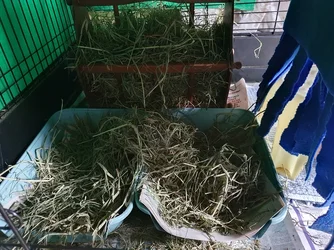
We actually dont recommend hay is put in any bags or hay holders. Instead we recommend it is just thrown in loose piles directly on the cage floor or put into multiple flat trays (with absorbent bedding at the bottom) in several areas around the cage so the piggies can get into the hay. (As you have three piggies you would want three (if not four) hay areas in the cage).
You want the piggies to be able to get right into a pile of hay - to be able to lay in it, on it, hide in it and be able to forage freely through it. Hay is their main food but it is also enrichment (they would naturally spend hours foraging for food so recreating that by not restricting their methods of feeding) and any bag or holder restricts their ability to be in hay consequently removes a lot of enrichment, foraging ability and mental stimulation. It is also the reason we do not recommend food bowls be used - scatter their veg and one tablespoon of pellets each around the cage or hide in hay piles so they have to move and search for it.
Also remember that they are not going to finish every strand of hay - not all hay is created equal!
You are going to throw hay away each day (either because they don’t consider it a tasty strand of hay or because it has been soiled; they need to be right in the hay so they are going to pee and poop on it) but you must be refilling with fresh hay at least once a day (I always do morning and night and sometimes in the middle of the day as well) whether they’ve eaten it or not.
In fact if they are eating all the hay you put in then you possibly aren’t giving them enough.
This thread will show you what we mean!
Show us your hay nests
The only way to know the are eating enough hay is with the routine weekly weight checks. Hay intake cannot be gauged by eye. You weigh them at the same time each week and keep a log of their weights.
If you have any concerns about their health, any concerns that weight has been lost then you switch to daily weight checks.
The guide I will add in below details further but anything up to 50g is a normal fluctuation but anything more than 50g of loss (is when it is officially considered loss) becomes concerning and requires action to be taken (syringe feeding and seeing a vet). 100g loss in 24-48 hours is an emergency situation.
https://www.theguineapigforum.co.uk/threads/weight-monitoring-and-management.171577/
Grid litter tray - if you post a picture that would be good but if it is what I am picturing then anything with holes in is not suitable for piggies feet. They may get toes caught but also standing on a holed floor can cause bumble foot.
They just need to be standing on absorbent bedding on the cage the floor, and you then spot clean it (once or twice) daily.
Veggies.
New vegetables need to be introduced slowly, in small quantities and one at a time. Fresh veggies (or fresh grass) on unprepared tummies can cause digestive problems. We recommend herbs are the things you start with as they tend to be more mild on the digestion.
For example:
Day 1 you give them one sprig of cilantro each. Day 2 also just one sprig of cilantro each.
Day 3 if they’ve been ok with cilantro, then add in one small piece of another veggie (eg a thin slice of bell pepper).
Day 4 give the cilantro and bell pepper again. Day 5 if still ok, then add in a slice of lettuce.
Day 6 still cilantro, bell pepper and lettuce.
Day 7 if all ok, then add in a slice of cucumber. Day 8 of all ok with cilantro, bell pepper, lettuce and cucumber, then you can start to slowly increase the quantities over the coming days until they are up to the recommended one cup of veg per pig per day.
If at any time you notice soft poops then you must remove all veg from the diet for several days, feeding only hay and allowing the gut to resettle before going back to day 1 again.
The four safe daily veggies are lettuce, bell pepper, cilantro and cucumber.
Anything else is in moderation and rotation.
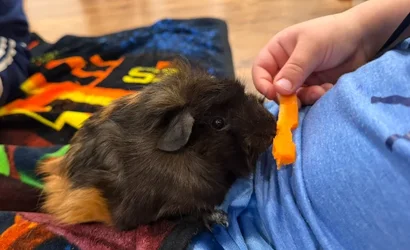
Fruit and carrots should not be in the diet regularly due to the sugars.
Kale, spinach and parsley are high calcium veggies so need to be once a week only. Calcium and oxalates can increase the risk of bladder stones with most calcium coming into the diet via pellets and drinking water (in hard water areas)
They can have just one tablespoon of pellets per pig per day
Long Term Balanced General And Special Needs Guinea Pig Diets



 Congratulations on becoming a piggy parent


 Unfortunately there is no real way of keeping the poops in a corner with piggies, they poop everywhere and need a daily or twice daily poop pick, but their poops are usually very nice and neat, so not too bad there. Lovely to see your piggy set up