• Discussions taking place within this forum are intended for the purpose of assisting you in discussing options with your vet. Any other use of advice given here is done so at your risk, is solely your responsibility and not that of this forum or its owner. Before posting it is your responsibility you abide by this Statement

Is Their Wee Right?

Reenie

Adult Guinea Pig
Joined
Jun 19, 2017
Messages
3,211
Reaction score
3,808
Points
1,275
Location
Kirkintilloch, Glasgow
There are always white chalky patches when I clean out the cage and I noticed them on the slabs when I had the piggies out in the garden (grass was out of bounds for a few days). I stopped giving them dandelion leaves as I read they were high in calcium to see if this helped but still the same. The thing is, when they pee in their bowl, it's a browny colour, so not sure what's going on. This is the first time I've used fleece, it was always shavings with the rescues so I never saw this before. Is there a calcium issue or is this normal?
 
There are always white chalky patches when I clean out the cage and I noticed them on the slabs when I had the piggies out in the garden (grass was out of bounds for a few days). I stopped giving them dandelion leaves as I read they were high in calcium to see if this helped but still the same. The thing is, when they pee in their bowl, it's a browny colour, so not sure what's going on. This is the first time I've used fleece, it was always shavings with the rescues so I never saw this before. Is there a calcium issue or is this normal?

Hi

Pee oxidises after it leaves the body, so it usually goes an orange and then increasingly rusty colour as it dries and ages. That is nothing to worry about, as long as any drying urine patches don't have small reddish dots in the patch or - if there is a fair amount of it in the uringe - a reddish ring in a different shade on the outside. A darker pee rim in the same hue as the inside is normal as the patch dries. Blood doesn't mix evenly with blood. Please see a vet if you notice the presence of blood in urine.

The odd milky calcium pee that dries to a whiteish powdery deposit is also nothing to worry about. However, if you see them regularly on a daily or near daily basis, you are feeding a diet that is too high in calcium and that can in the longer term contribute to the build up of bladder stones and sludge since guinea pigs have naturally very alkaline urine, which makes them very prone to problems with the urinary tract. It is unfortunately not quite as straight forward as cutting any calcium out of the diet, but you may find our sample diet picture in the diet guide good starting point. Please also keep in mind that hard water can be the biggest contributor to calcium and that some pellet brands also contain a higher content of calcium than other; you really need to look at the whole food range. Follow the tips in our guide. I have made it as clear and as detailed as possible. The recommendations are based on long term experienciences.
Recommendations For A Balanced General Guinea Pig Diet
 
Hi

Pee oxidises after it leaves the body, so it usually goes an orange and then increasingly rusty colour as it dries and ages. That is nothing to worry about, as long as any drying urine patches don't have small reddish dots in the patch or - if there is a fair amount of it in the uringe - a reddish ring in a different shade on the outside. A darker pee rim in the same hue as the inside is normal as the patch dries. Blood doesn't mix evenly with blood. Please see a vet if you notice the presence of blood in urine.

The odd milky calcium pee that dries to a whiteish powdery deposit is also nothing to worry about. However, if you see them regularly on a daily or near daily basis, you are feeding a diet that is too high in calcium and that can in the longer term contribute to the build up of bladder stones and sludge since guinea pigs have naturally very alkaline urine, which makes them very prone to problems with the urinary tract. It is unfortunately not quite as straight forward as cutting any calcium out of the diet, but you may find our sample diet picture in the diet guide good starting point. Please also keep in mind that hard water can be the biggest contributor to calcium and that some pellet brands also contain a higher content of calcium than other; you really need to look at the whole food range. Follow the tips in our guide. I have made it as clear and as detailed as possible. The recommendations are based on long term experienciences.
Recommendations For A Balanced General Guinea Pig Diet
Thanks for this. I'll have a look at their pellets and the diets and see if I can figure out what's causing it. I'm in Scotland so we have very soft water - not that they drink much of it. Thanks again
 
white spots made of white powder (not similar to sands) is normal as as Wiebke said it is only an excess of calcium excreted with the wee. Piggies absorb calcium only if there is also a certain ratio of phosphorus, therefore these two minerals should keep a perfect balance. On Guinea Lynx there is an online calculator which can be useful, at least for doing some experiment mixing the vegs in the right way. Consider that wild common grass has the perfect balance and if you feed your piggies only with grass you will no more see any white spots.
Good quality pellets have the right ratio calcium/phosphorus and you can check the ratio written in the label.
The water: if your piggies drink quite a lot I would give them the water for preparaing newborns' formula milk, it is extremely cheap at the supermarket (I pay 1€ 6 bottles/9liters! I use it for our afternoon tea because roman water is extremely hard and ruin the kettle). Its fixed residual is 20-30mg/liter only and I don't think the soft public water is so low in minerals.
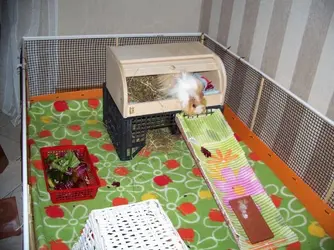
I also had found these spots, look the tile on the ramp at the picture below; now I have not seen any spots for months
100_6586.webp
the fleece is very good also for checking such spots, especially if underneath you have a proper absorbant layer (I use newspapers which keep the colour and the residuals, I showed also some pieces of wet paper to the vet because I had some doubt).
Now my piggies eat a lot of dandelion leaves, but also another grass which is rich of other minerals and keep the balance perfect. And no pellets.
 
Back
Top