• Discussions taking place within this forum are intended for the purpose of assisting you in discussing options with your vet. Any other use of advice given here is done so at your risk, is solely your responsibility and not that of this forum or its owner. Before posting it is your responsibility you abide by this Statement

just don't know what to do for the best

Status
Not open for further replies.
Wow. That is an excellent letter. Good for you.

It angers me that I am legally obliged to pay for vet treatment when my guinea-pigs and rabbits are sick, yet most vets know very little about them. The last time I took my rabbit to a different vet I was testing out, he told me guinea-pigs and rabbits can make good companions for each other... (I jest not.)
 
Got this reply from the RCVS........

It's what I presumed it would pretty much be grrrr
They just don't recognise a Rodentologist abilities :(
However, I await to hear more about why there is not enough taught to vets in their training about guinea pigs (thanks AP)
I haven't yet heard from my vet grrrr Depending on what he has to say will depend on whether I think it will be relevant to complain further.
Anyway, have a read.
I have deleted my name and my vets name :)

Dear Mrs x,

I write further to your emails to the department and our telephone conversation of 13 November 2009.

I acknowledge your concerns as outlined in the letter attached to your first email, and note that Mr x may well respond to your points in a way that may satisfy you; however it may be useful for you to consider what advice the RCVS can provide.

The College has statutory responsibilities under the Veterinary Surgeons Act 1966 to regulate the professional conduct of veterinary surgeons; specifically in regard to allegations of serious professional misconduct. The College also has a function to provide informed opinions on animal health and welfare issues; however the College is bound by the Veterinary Surgeons Act 1966 and can only advise within those parameters and similarly only in accordance with other relevant legislation.

It may be worth setting out the legislation. Under the Veterinary Surgeons Act 1966 (“The Actâ€), in general only veterinary surgeons registered with the RCVS may practice veterinary surgery.

Section 19 of the Act states:-

“19 Restriction of practice of veterinary surgery by unqualified persons

(1) Subject to the following provisions of this section, no individual shall practise, or hold himself out as practising or as being prepared to practise, veterinary surgery unless he is registered in the register of veterinary surgeons or the supplementary veterinary register, and an individual who acts in contravention of this subsection shall be liable—
(a) on summary conviction to a fine not exceeding [the prescribed sum]
(b) on conviction on indictment to a fine.

‘Veterinary Surgery’ as defined in the Act "means the art and science of veterinary surgery and medicine and, without prejudice to the generality of the foregoing, shall be taken to include-

(a) the diagnosis of diseases in, and injuries to, animals including tests performed on animals for diagnostic purposes;
(b) the giving of advice based upon such diagnosis;
(c) the medical or surgical treatment of animals; and
(d) the performance of surgical operations on animals."

There are a number of exemptions in the Act on the practice of veterinary surgery, and these are found in Schedule 3 to the Act. These exemptions pertain to animal owners, listed and student veterinary nurses and agricultural workers amongst others. I note that the rodentologist you mention is not a veterinary surgeon or a person that comes within the exemptions of Schedule 3; therefore by diagnosing disease and carrying out medical treatment, the rodentologist is in breach of the legislation and the College can therefore not support them. Indeed, the legislation may provide for why your practice is unwilling to work in conjunction with a rodentologist.

If you wish to view the Act (including Schedule 3), you can access it at the following link: http://www.rcvs.org.uk/shared_asp_files/uploadedfiles/%7B7B8B2869-29CD-4D39-BF0C-D3B5FC33CE28%7D_act_0104.pdf

I note that you are aware of the Veterinary Medicines Cascade. The RCVS Guide to Professional Conduct for veterinary surgeons states the following in part 2H:

11. If there is no suitable authorised veterinary medicinal product in the United Kingdom for a condition in a particular species, in order to avoid unacceptable suffering veterinary surgeons may exercise their clinical judgement according to the 'Cascade', whereby they select in the following order

a. a veterinary medicinal product authorised in the United Kingdom for use with another animal species, or for another condition in the same species (off-label use); or

b. if, and only if, there is no such product that is suitable, either:

i. a medicinal product authorised in the United Kingdom for human use; or

ii. a veterinary medicinal product not authorised in the United Kingdom but authorised in another European Member State for use with any animal species (in the case of a food-producing animal, it must be a food-producing species); or

c. if, and only if, there is no such product that is suitable, a veterinary medicinal product prepared extemporaneously by a pharmacist, a veterinary surgeon or a person holding a manufacturing authorisation authorising the manufacture of that type of product.

12. A decision to use a medicine which is not authorised for the condition in the species being treated where one is available should not be taken lightly or without justification. In such cases clients should be made aware of the intended use of unauthorised medicines and given a clear indication of potential side effects. Their consent should be obtained in writing. In the case of exotic species most of the medicines used are unlikely to be authorised for use in the UK and owners should be made aware of and consent to this from the outset.

The guidance can be accessed in full at the following link: http://www.rcvs.org.uk/Templates/Internal.asp?NodeID=92574&int2ndParentNodeID=89737&int1stParentNodeID=89642.

The Veterinary Medicines Directorate (VMD) are the appropriate body for veterinary medicines, and enforce the Veterinary Medicines Regulations 2009. The VMD produce a guidance note on the use of the cascade, which can be accessed at the following link: http://www.vmd.gov.uk/General/VMR/vmgn/VMGNote15.pdf.

I appreciate from your letter that you are not satisfied with the service given to you by your veterinary practice. As indicated above, Mr x may well respond constructively to your concerns and we recommend that a response is obtained in the first instance, but should you wish to submit any formal complaint to the RCVS then the necessary procedures can be viewed at the following link: http://www.rcvs.org.uk/Templates/Internal.asp?NodeID=89916&int1stParentNodeID=89644.

 
Finally, you have asked about undergraduate training about guinea pigs, and whether veterinary surgeons can undertake certain training courses to expand their clinical knowledge. As we had discussed, veterinary surgeons should be satisfied in their ability to provide for the services they are offering, and may therefore direct their Continuing Professional Development (CPD) to the area of their professional activities, so they can achieve this. I have forwarded this particular concern to the RCVS Head of Education Department for any further advice that she may be able to provide, and will contact you with any information.

Yours sincerely,


Christopher Murdoch

Professional Conduct Department
Royal College of Veterinary Surgeons
Belgravia House
62-64 Horseferry Road
London SW1P 2AF
020 7202 0789
 
The reply is along the lines that I expected. The response hides behind the legislation of the 1966 Act. I note that the majority of the letter relates to those who are not qualified to treat animals within the definitions of the Act.
It is only in the last, brief, paragraph, that note is taken of the concerns that vets receive no pre-qualification training on guinea pigs and that it is left to the individual vet as to whether they undertake further courses to remedy this omission.
If it is illegal for non-veterinary qualified people to treat guinea pigs, is it not also illegal, and unethical, for vets to treat those species on which they have received no compulsory training?
 
Would a vet go to a newly qualified doctor for brain surgery, or to a newly qualified dentist for reconstructive oral surgery? Where a member of either profession attempts treatment outside their knowledge, or training, they render themselves open to disciplinary measures.
However, a vet is allowed from day one to treat species which they have no specialist knowledge. How many vets, faced with this situation, are honest enough to admit their lack of knowledge and to withdraw from the case?
 
Hope your vet DOES reply too. Interesting to see what they say.

AP makes some very very valid points and it's a shame it's such a blinkered viewpoint / old legistaltion.

It seems that rules on political correctness (and other similar things) can be changed in a flash while this kind of thing stays archaic year after year even when it concerns the welfare of living creatures. Senseless
 
I used to work in a vets and if they didn't have any knowledge on a animal that came in such as gp or birds etc they would refer them to a vet that had specialised in that area rather than just diagnose what they thought it was, but saying that i know alot of vets just diagnose the wrong things if they have no knowledge and reel you a load of jargon for you to think that they know what they are talking about.
Its just lucky that everyone on here has good/some knowledge and share that with others on here.

I'm glad that you at least got a reply from them and fingers crossed that the vet will reply too.
 
For anyone who was following this thread Poppy has a infestation of parasites which was absolutely awful to see under a microscope :( She has itrafungal oral medication and is to be shampooed with flea or die, as have all the other girls and has been recommended a joint formula for her arthiritis, which I mentioned to Laura in the previous post.
If one thing I have learnt from this that I can pass on to others is that I stupidly thought Herbage hay was ok to give my piggies as it was quality looking hay and they loved it, I kept wondering why despite bathing the girls with lice and easy that poor Poppy seemed to not be able to shift her parasites. Vedra explained to me about oxbow hay being ok and the process it goes through, hence I will never buy any other hay again after what I saw under the microscope it really hit home to me :( The girls do have readigrass which some of them like more than others so I'm glad I can still give them a hay which I won't have to worry about causing parasite problems. I know I never want to see poor Poppy have to be poorly like this again :(

Did she have internal parasites or just external ones?
 
It is not just parasites on the surface in Poppy's case, it has affected her system internally, although she is eating, her appetite is poorer than usual and whatever she is eating the parasites are taking all the nutrients :(
I am praying she will get better soon :) She has now lost almost 200g in six weeks :( I dread putting her on the scales :( I am hoping she will start to show some improvement with being on the medication. Her 2nd bath is due on Friday, I am going to give her a third bath the following Friday also :)
 
Just wanted to add Poppy was being bathed every 4-6 weeks with lice and easy repeted 7 days after and wormed every 3-4 months, cleaned out every day, kept on vetbed, given what I thought was ok hay, it has to be the hay that was the problem, just wish I knew about the risks to her health :(
 
I haven't had chance to read through all the thread so just going to type out a reply. Sorry for any repeats of what's already been said! One of my pigs Poppet has a suspected fungal infection a few months ago. It was quite horrendous, her glands were swollen and she had an enormous patch of fungal around her eye, scabby lumps under her arms and a huge patch on her back. The vet prescribed Baytril as he was worried the patches could get infected which I continued, I also used Daktarin cream on the sore, open patches and used Nizoral shampoo which I have to say is excellent. When shampooing you need to work the shampoo into the skin, particularly around the sore patches, and leave on for 5-10 minutes. You can repeat this as often as you want. Touch wood, Poppet's glands went down and the fungal infection cleared. I'm not saying it will definately work for you, but I was so worried too, and I was so glad I tried the Nizoral and Daktarin. Also get yourself off to Pets at Home and get some Vetark Pro-C Probiotic, it's completely safe and does wonders. It supports the immune system and now I always give it to sick pigs just to help perk them up and keep them in the best health possible :)
 
Thank you for the reply Tracy :) We have been feeding Poppy science recovery which she likes the taste of :) She will just eat it out of a bowl if I mix it like a paste consistency :)
Poppy's condition is parasitic rather than fungal, there really isn't hardly any visible hair loss apart from the tiniest bit of thinning at the top of her front leg :)
 
Like above I havent read through all the threads but did your vet put her under the ultra violet light?

venice
 
wormed every 3-4 months, cleaned out every day, kept on vetbed, given what I thought was ok hay, it has to be the hay that was the problem, just wish I knew about the risks to her health :(

Wow! How come the wormer you were using wasn't killing the internal parasite? Do you know the name of the parasite that Vedra called the 'silent killer', as I really want to read-up on it?

I just wanted to say: I'm really sorry this has happened to your piggy. :( I hope she gets better soon. It sounds like you were doing everything you could to prevent something like this from happening; don't beat yourself up.

I also want to thank you for bringing this parasite to our attention; I just wish we could have known about it without you and your piggy going through such a horrible time. :(
 
Last edited:
Good question Furries, something I never thought about. Worming is supposed to prevent this sort of thing, yet Poppy still got these parastes...

Although, upon further thought, worming is like all things preventative i.e. vaccinations. You can still get an active case of the illness, the preventative treatment just makes it that bit harder for the problem to develop/infect in the first place. It doesn't guarantee it will never happen, but if one is exposed to the parasite (or illness) enough it can affect the body.
 
Different parasites, different treatment. Panacur, Valabazen, Ivomec are all useful in their own way.
It is a fortunate pig that never gets any problems.
 
I always believed that dosing once every three months with both Panacur and Ivomec (or Valazen and Ivomec) covered the full spectrum of parasites - is that not quite the case?
 
I know that with humans, you can purge (treat for) tapeworms and the person can immediately reinfect him/herself (if they're not careful). I guess that is the same with guinea-pigs - they can be wormed, but then immediately be reinfected, so the idea of the wormer is just to keep the worm burden down? Somebody correct me if this is no longer the case; my knowledge is 12-years-old!

(And I hope I haven't scared anybody about the thought of tapeworms in humans; the ones I'm thinking of tend to be found in countries where hygiene isn't high on the agenda and meat isn't screened for these parasites.)
 
Do you know which parasite it is?
It is possible for parasites to cause irreversible damage so that, even if the parasites have been eliminated, the problem continues. There can be a poor prognosis.
 
I know that with humans, you can purge (treat for) tapeworms and the person can immediately reinfect him/herself (if they're not careful). I guess that is the same with guinea-pigs - they can be wormed, but then immediately be reinfected, so the idea of the wormer is just to keep the worm burden down? Somebody correct me if this is no longer the case; my knowledge is 12-years-old!

The statement I highlighted is what I was thinking. If a pig was wormed and was then grazing on hay infested with parasites soon after, worming is not going to be as effective - or the effects of the wormer are not going to last very long/protect the pig for long.
 
Do you know which parasite it is?
It is possible for parasites to cause irreversible damage so that, even if the parasites have been eliminated, the problem continues. There can be a poor prognosis.
It began with the letter T. :red I will recognise the name of it if you can think of what it could be.
Poppy is still the same eating and drinking and pottering about as usual :) Her weight is still at a loss :( I am probably rather paranoid about it, wanting to weigh her every evening after her supper veg and then wishing I hadn't when I see it is another loss.
I keep telling myself it is early days.
It is the drops (2 drops) Ivomec and Panacur my rodentologist worms her with and just a reminder the Itrafungal Vedra gave plus being bathed with the flea or die. I am thinking hopefully any eggs will be done away with on friday when she is bathed. Maybe then I will start to see an improvement.
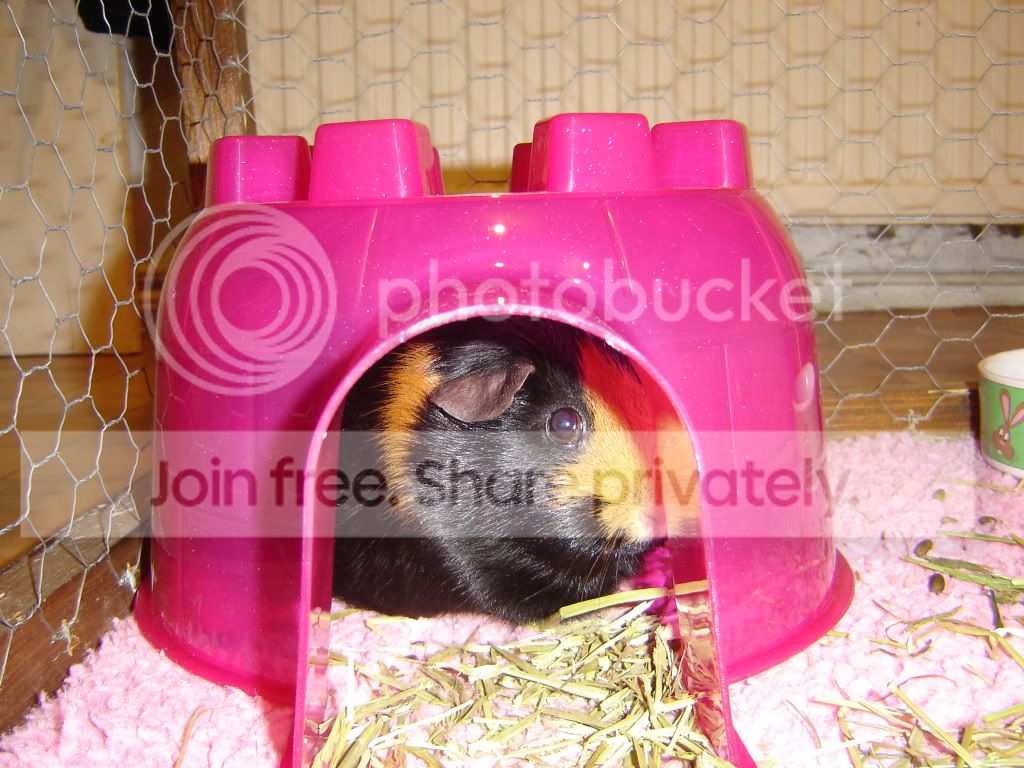
The sad thing about it is she dosen't look ill. She's always been quiet compared to the others and picky with all her veg, I just put it down to her being the oldest. My OH keeps telling me to give her time to get better. I feel so sad though I cried myself to sleep last night thinking that I am going to lose her, I was looking after my friends two year old today and when he fell asleep I was just staring into space crying thinking about wanting to get home to see if she is still ok 8... I have bought her a new pink sparkly pigloo today which she likes :)
Still nothing from my vet grrrr I am taking our rabbit Teddy tomorrow evening for his VHD vaccination. Will be interesting to see if they try and bill me for Poppy's consultation from last week rolleyes
 
The only 'T' parasite I can think of is trixacarus caviae - although my knowledge on that is limited. I will ask Vedra when I call tonight.

The Itrafungol should be good for Poppy, it can take a few days to kick in. Her age may have a little to do with it as well, they seem to go through weight loss phases as they get older. Try not to worry yourself too much - although I do know how you feel, I did the same when Charlie was diagnosed with his tumour and when Tuppy had similar problems to your Poppy. Poppy doesn't look ill so it's unlikely there would be a sudden change in that, especially with treating her for what problems have been diagnosed.

Take each day at a time; I'm sure before you know it she'll be feeling better soon. How's her arthritis doing? Delilah's bottle of R~A arrived today (thank you so much for telling me about it) and she much prefers that to the tablets!

Oh, and don't forget we need pics of this sparkly pigloo!
 
Thanks Laura, ask about Poppy specifically if you can, hopefully Vedra will tell you if you say you know me and I was asking.
I am just in floods of tears 8... 8... 8... I don't think I could bear to lose her, she means the world to me, we treat her like a baby. I have done nothing but cry on and off this week, probably hormonal reasons too.
She is definately better with her back legs, I have noticed that when she gets squidged down she doesn't jiffle around for a while trying to decide where to put her legs to get comfy like she used to if that makes sense. She has just been squidging down without any problem :)
Peggy is still being a rumbly so and so rolleyes
I will get a piccy later of her new pigloo :)
 
DSC05257.jpg
:)
 
Aww. She looks so cute! It's like having your own giant Lego brick to hide inside (I love Lego).

How many squeakers can fit in a pigloo?
 
Poppy has gained a bit of weight - 21g since Sunday :) This is her first weight gain since 4th October - she weighed 1102g then and on Sunday just gone, she was right down to 965g.
Tonight she is 986g :) I know it is early days and I usually weigh her on Sundays but it's hopefully a good sign :)
 
That letter was brilliant, and it makes me sooooooooooo angry when they come back with stuff like that as an answer! GRRRRRRRR!

Poppy looks like she's enjoying her pigloo, hope she's ok. Good luck with the vet visit x
 
So thrilled to hear that Poppy has gained some weight and she looks very happy in her sparkly pigloo just like a princess. :)
 
Status
Not open for further replies.
Back
Top