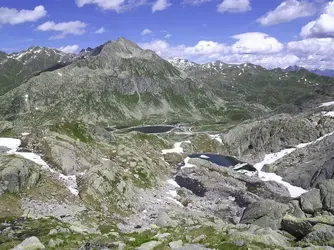
After totting up all the little numbers after the dot in my weekly total, I have actually reached the Gotthard Pass at 2120 m a day earlier than expected tonight!
The southern side is another feast of serpentines while on the northern access you get plenty of tunnels when you drive up over the top and not through the big tunnels of the motorway or railway far below. The passes are only open to the public during the summer months once the snowfalls have stopped (usually June to September).
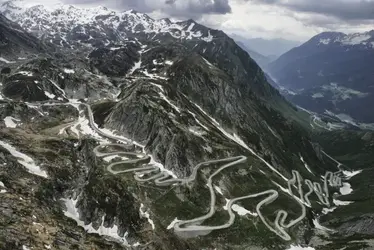
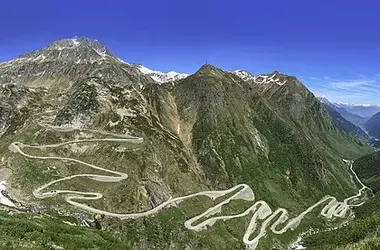
If you want to get a feel of driving up all those serpentines in a car and cross the pass on the old road, then watch this video here. I have been over the top twice and both times found it a special experience:
Even more often, I've been through it on the train or on the motorway.
The Gotthard is one of the main Alpine passes; the most direct connection between Northern Italy and the Rhine/Germany but it is also geographically very interesting. Not because it is the highest (which it isn't) but because the Gotthard massif is also called the 'Roof of Europe' as it is the continental watershed of Western Europe. To the south, all water flows via the Po river the Adriatic Sea, to the west lies the source of the Rhone, which runs to the Western Med. All the rivers to the north and northeast (including the two branches of the Rhine itself) head toward the North Sea. And to the east lies the head of the Engadin Valley, which joins the Danube on its long way to the Black Sea. The only European sea that doesn't get any water from Switzerland is the Baltic Sea! Which other area can lay claim to that?!
A small section at the top of the pass is still kept cobbled in memory of the mail carriages that used to cross the pass.

Juat spare a thought of those 18th century Grand Tour aristocrats and their entourage, who had to cross the pass in an open chair affair carried by two locals on what was then no more than a path that could be very slippery in the fog and rain.

On the way up from Lake Lucerne, the village church of Wassen is a famous landmark as you pass it three times on three levels on the train, winding up in several corkscrew tunnels in the very narrow and steep valley from one level to the next.

Here is the model railway version, which nicely displays the three levels:

The southern side is another feast of serpentines while on the northern access you get plenty of tunnels when you drive up over the top and not through the big tunnels of the motorway or railway far below. The passes are only open to the public during the summer months once the snowfalls have stopped (usually June to September).
If you want to get a feel of driving up all those serpentines in a car and cross the pass on the old road, then watch this video here. I have been over the top twice and both times found it a special experience:
The Gotthard is one of the main Alpine passes; the most direct connection between Northern Italy and the Rhine/Germany but it is also geographically very interesting. Not because it is the highest (which it isn't) but because the Gotthard massif is also called the 'Roof of Europe' as it is the continental watershed of Western Europe. To the south, all water flows via the Po river the Adriatic Sea, to the west lies the source of the Rhone, which runs to the Western Med. All the rivers to the north and northeast (including the two branches of the Rhine itself) head toward the North Sea. And to the east lies the head of the Engadin Valley, which joins the Danube on its long way to the Black Sea. The only European sea that doesn't get any water from Switzerland is the Baltic Sea! Which other area can lay claim to that?!
A small section at the top of the pass is still kept cobbled in memory of the mail carriages that used to cross the pass.
Juat spare a thought of those 18th century Grand Tour aristocrats and their entourage, who had to cross the pass in an open chair affair carried by two locals on what was then no more than a path that could be very slippery in the fog and rain.
On the way up from Lake Lucerne, the village church of Wassen is a famous landmark as you pass it three times on three levels on the train, winding up in several corkscrew tunnels in the very narrow and steep valley from one level to the next.
Here is the model railway version, which nicely displays the three levels: