

GuineaPiggie
Junior Guinea Pig
- What is muesli or dry mix and what is the difference between a mix and pellets?
- Why is selective feeding problematic?
- How do we know this information?
- Vitamin C
- How much pellets do I give my guinea pigs?
- Pellets as syringe feed in an emergency
- Switching your guinea pigs from muesli to pellets
Some of us may be used to feeding muesli/dry mix to piggies in years gone by but these days there is a much wider range of products and brands available with better nutritional content.
Muesli is also referred to as dry mix or mixture foods or colloquially as kibbles. Pellets are also referred to as nuggets.
What is muesli and what is the difference between a mix and pellets?
Muesli is a food that consists of a variety of different foods including flaked pea and corn, sunflower seeds, alfalfa nuggets, oats and a range of other foods. Muesli mixes have also been known to contain pieces of twig, stone and other harmful items.
The seeds and nuts in muesli are high in fat. Often times the mixtures include sunflower seeds. Sunflower seeds in the shell are dangerous, not just because of high fat content, but because the shells splinter into sharp pieces that can cut and get stuck in your piggie’s mouth and throat.
Pellets are usually brown and a uniform size and shape depending on the brand. They vary in size and shape for each brand, for example, Burgess have crescent shaped pellets while Science Selective have star shaped pellets.
In each bag of pellets, each pellet will be exactly the same size, shape, colour and will have the exact same ingredients and nutritional values, therefore preventing selective feeding.
Why is selective feeding problematic?
Guinea pigs will just eat the sweet bits and leave the bits they don’t like which are the bits containing fibre and other important nutrients. This means they don’t get enough vitamins and minerals in their diet which is can be linked to painful dental disease and intestinal problems. This is called 'Selective feeding' and only happens whenever the guinea pig has a choice of different components of their dry food. Feeding pellets will avoid selective feeding but remember that the main part of a guinea pigs diet should always be hay (Meadow hay/Orchard Hay and Timothy Hay are good choices).
How do we know this information?
A study by NCBI concluded that muesli led to a unbalanced diet in rabbits which is strongly believed to be the same in guinea pigs. It was also found that the amount of hay and water consumed was considerably less.
''Selective feeding occurred in rabbits fed muesli. Pellets were rejected, and grains and extrudates selected. The presence of selective feeding in all rabbits fed muesli leads to the consumption of an unbalanced diet. In addition, hay intake and water intake were lower when muesli was consumed. The study demonstrates that the feeding of muesli diets cannot be recommended.'' (www.nih.gov)
There has been also been numerous studies which suggest that guinea pigs live longer and healthier lives when fed on pellets as opposed to muesli, due to the fact they receive a better, more balanced and nutritional intake of food.
Vitamin C
Guinea pigs have a mutated gene that prevents them from converting glucose to ascorbic acid. Basically, like humans, guinea pigs can’t synthesize their own Vitamin C. In order to ward off scurvy, diet must provide it. Most Guinea pig muesli and pellets claim to have added Vitamin C. The problem is, it loses its potency over time. It is a good idea check the expiration date on the package, as the added Vitamin C is only active for 3 months after the dry food were produced, provided it has not been exposed to high heat or other conditions that would break it down faster.
Good quality pellets have a higher quality of Vitamin C than muesli. If you feed pellets, you are guaranteeing a consistent amount of Vitamin C in each bowl, opposed to muesli which varies from bowl to bowl.
How much pellets do I give my guinea pigs?
We recommend to feed up to 2 tablespoons of pellets to guinea pigs under 4 months. Teenagers and adults should only have 1 tablespoon per guinea pig per day.
Instead of bowl feeding pellets and veg, sprinkle them around the cage. This is vital enrichment that encourages the natural foraging instinct. minimises food bullying and eliminates bowl soiling.
Pellets as syringe feed in an emergency
In an emergency you can make an impromptu syringe feed for a piggy that has suddenly stopped eating from mushed up pellets that have been soaked in boiled, cooled water - that can help to keep it going until can be seen by vet and until recovery food can be ordered online.
This can be problematic with a dry mix.
Changing your Guinea Pigs from Muesli to Pellets.
It is advisable to do a slow switch, but not all piggies will be so obliging as to take to pellets and some can be quite persistent. The best way to do it is to slowly add more of the pellets and less of the muesli over a period of about 5 days until your Guinea Pigs are just eating pellets.
If a piggy refuses to shift on a slow switchover, you may need to go cold turkey and wait until your piggy gives in. This especially in cases where you introduce a new guinea pig or two and want to change the diet for your existing piggy. If you have an old guinea pig, it may be kinder to leave it on the diet it is used to if it is not happy with a switch.
It may be advisable to feed more vitamin C during the switching over period incase your guinea pigs are not eating their normal amount of pellets/muesli and are perhaps not getting their full amount of Vitamin C due to this.
Here is our pellets guide
Sadly, pellets are still not available in all countries, or only at considerable effort and expense.
- Why is selective feeding problematic?
- How do we know this information?
- Vitamin C
- How much pellets do I give my guinea pigs?
- Pellets as syringe feed in an emergency
- Switching your guinea pigs from muesli to pellets
Some of us may be used to feeding muesli/dry mix to piggies in years gone by but these days there is a much wider range of products and brands available with better nutritional content.
Muesli is also referred to as dry mix or mixture foods or colloquially as kibbles. Pellets are also referred to as nuggets.
What is muesli and what is the difference between a mix and pellets?
Muesli is a food that consists of a variety of different foods including flaked pea and corn, sunflower seeds, alfalfa nuggets, oats and a range of other foods. Muesli mixes have also been known to contain pieces of twig, stone and other harmful items.
The seeds and nuts in muesli are high in fat. Often times the mixtures include sunflower seeds. Sunflower seeds in the shell are dangerous, not just because of high fat content, but because the shells splinter into sharp pieces that can cut and get stuck in your piggie’s mouth and throat.
Pellets are usually brown and a uniform size and shape depending on the brand. They vary in size and shape for each brand, for example, Burgess have crescent shaped pellets while Science Selective have star shaped pellets.
In each bag of pellets, each pellet will be exactly the same size, shape, colour and will have the exact same ingredients and nutritional values, therefore preventing selective feeding.
Why is selective feeding problematic?
Guinea pigs will just eat the sweet bits and leave the bits they don’t like which are the bits containing fibre and other important nutrients. This means they don’t get enough vitamins and minerals in their diet which is can be linked to painful dental disease and intestinal problems. This is called 'Selective feeding' and only happens whenever the guinea pig has a choice of different components of their dry food. Feeding pellets will avoid selective feeding but remember that the main part of a guinea pigs diet should always be hay (Meadow hay/Orchard Hay and Timothy Hay are good choices).
How do we know this information?
A study by NCBI concluded that muesli led to a unbalanced diet in rabbits which is strongly believed to be the same in guinea pigs. It was also found that the amount of hay and water consumed was considerably less.
''Selective feeding occurred in rabbits fed muesli. Pellets were rejected, and grains and extrudates selected. The presence of selective feeding in all rabbits fed muesli leads to the consumption of an unbalanced diet. In addition, hay intake and water intake were lower when muesli was consumed. The study demonstrates that the feeding of muesli diets cannot be recommended.'' (www.nih.gov)
There has been also been numerous studies which suggest that guinea pigs live longer and healthier lives when fed on pellets as opposed to muesli, due to the fact they receive a better, more balanced and nutritional intake of food.
Vitamin C
Guinea pigs have a mutated gene that prevents them from converting glucose to ascorbic acid. Basically, like humans, guinea pigs can’t synthesize their own Vitamin C. In order to ward off scurvy, diet must provide it. Most Guinea pig muesli and pellets claim to have added Vitamin C. The problem is, it loses its potency over time. It is a good idea check the expiration date on the package, as the added Vitamin C is only active for 3 months after the dry food were produced, provided it has not been exposed to high heat or other conditions that would break it down faster.
Good quality pellets have a higher quality of Vitamin C than muesli. If you feed pellets, you are guaranteeing a consistent amount of Vitamin C in each bowl, opposed to muesli which varies from bowl to bowl.
How much pellets do I give my guinea pigs?
We recommend to feed up to 2 tablespoons of pellets to guinea pigs under 4 months. Teenagers and adults should only have 1 tablespoon per guinea pig per day.
Instead of bowl feeding pellets and veg, sprinkle them around the cage. This is vital enrichment that encourages the natural foraging instinct. minimises food bullying and eliminates bowl soiling.
Pellets as syringe feed in an emergency
In an emergency you can make an impromptu syringe feed for a piggy that has suddenly stopped eating from mushed up pellets that have been soaked in boiled, cooled water - that can help to keep it going until can be seen by vet and until recovery food can be ordered online.
This can be problematic with a dry mix.

1 Feed
- Important crisis management resources
- When is improvising necessary?
- Which food group am I replacing with my feeding support?
- How much and how often should I feed and water?
- What can I use that I have already got at home?
- Other possible easily available foods with their pros and cons
- How do I prep a syringe for rougher pellet fibre?
- What can I do without a syringe?
- The role of lukewarm water
2 Probiotics
- Probiotic products...
- Important crisis management resources
- When is improvising necessary?
- Which food group am I replacing with my feeding support?
- How much and how often should I feed and water?
- What can I use that I have already got at home?
- Other possible easily available foods with their pros and cons
- How do I prep a syringe for rougher pellet fibre?
- What can I do without a syringe?
- The role of lukewarm water
2 Probiotics
- Probiotic products...
- Wiebke
- Replies: 0
- Forum: Emergency Information and Care


Changing your Guinea Pigs from Muesli to Pellets.
It is advisable to do a slow switch, but not all piggies will be so obliging as to take to pellets and some can be quite persistent. The best way to do it is to slowly add more of the pellets and less of the muesli over a period of about 5 days until your Guinea Pigs are just eating pellets.
If a piggy refuses to shift on a slow switchover, you may need to go cold turkey and wait until your piggy gives in. This especially in cases where you introduce a new guinea pig or two and want to change the diet for your existing piggy. If you have an old guinea pig, it may be kinder to leave it on the diet it is used to if it is not happy with a switch.
It may be advisable to feed more vitamin C during the switching over period incase your guinea pigs are not eating their normal amount of pellets/muesli and are perhaps not getting their full amount of Vitamin C due to this.
Here is our pellets guide

Pellet brands comparison chart (incl. international sold brands)
The chart in this post has been last updated: October 2024
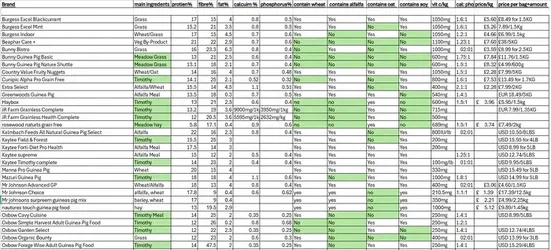
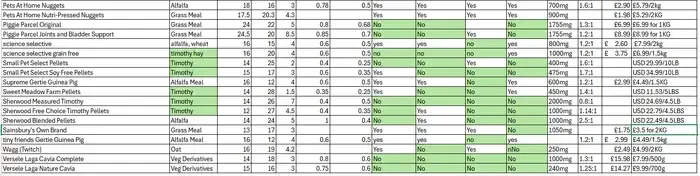
So after looking at the different foods available and finding that the information is spread all over the place I have started to compile a spreadsheet of the nuggets available here in the UK (and most in other countries). I am still gathering information but I have put the basics into a spreadsheet so that they can all be compared together.
If there is anything else you...
The chart in this post has been last updated: October 2024
So after looking at the different foods available and finding that the information is spread all over the place I have started to compile a spreadsheet of the nuggets available here in the UK (and most in other countries). I am still gathering information but I have put the basics into a spreadsheet so that they can all be compared together.
If there is anything else you...
Sadly, pellets are still not available in all countries, or only at considerable effort and expense.
Last edited by a moderator: