CTWC
Forum Donator 2025/26
Hi how is your baby? 


Thank you very much for your concern and care. My baby is currently doing well in all aspects, but occasionally has some indentations. I also checked his stool, which showed two plus signs for yeast. I just learned on the website that indented soft stools may be caused by overgrowth of yeast in the intestines: a veterinarian can diagnose and treat this with oral nystatin.Hi how is your baby?

I must say, you are so experienced and knowledgeable! When I first joined this forum, you had already analysed the situation and pointed me in the right direction. But Chinese veterinarians, you know how it is! Actually, I followed your advice, but in the end, I feel like our pet was neglected. When the vet saw his urine, they only told me to treat it as cystitis for now and gave me some painkillers and anti-inflammatory drugs. The painkillers were only for one day, and the small amount was insufficient to help him—it would have been better not to give them at all. The anti-inflammatory medication was even worse. I repeatedly asked for a follow-up examination, but he said it wasn't necessary. It wasn't until I noticed he was experiencing pain and seizures again that I emailed a British veterinarian. He kindly suggested I take him for a comprehensive ultrasound examination, which is how we finally discovered the ovarian cyst. What’s most ridiculous is that the doctor didn’t prescribe any medication at all. I had already guessed as much, so I only used the Chinese hospital for the ultrasound scan. I never intended to rely on them for any further assistance. Another thing that left me both amused and exasperated was that the vet didn’t even include the size of the cyst in our examination report! Nowadays, more and more people are raising pigs in our country, and there are also more so-called guinea pig experts in veterinary hospitals. Unfortunately, how many pigs die every day at the hands of these ridiculous veterinarians!It is good they did the scans and gave you meds to help her gut movement. Her poops are looking good. Does she have any rough, dry skin on her nipples? Female guinea pigs can get ovarian cysts and the first sign of them is crusty nipples. Does she get hay all the time? They need to have hay always available. I hope she gets better and the bleeding stops
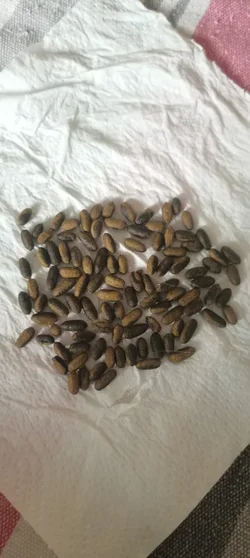
His weight today is 882 grams, which is 18 grams less than yesterday, and his poop today is a little smaller and a little pointed. Mum says his stomach is particularly unstable.As I think I explained earlier in the thread, Indents in poop is often due to minor tummy upset (and if the indents are not happening very often then I would not be overly concerned - I definitely would not be giving any medication for it at present) . You simply remove all fresh food and veg from the diet, increase hay intake and give the gut a few days to settle down before slowly reintroducing veg. You do not need to give any medication at this point and not before giving the gut time to settle down by removing veg
His weight today is 882 grams, which is 18 grams less than yesterday, and his poop today is a little smaller and a little pointed. Mum says his stomach is particularly unstable.


I also have the same confusion as you, I clearly asked the doctor last time when we found the ovarian cyst, the doctor said that at that time my report, the doctor indeed diagnosed her ovarian cyst, but there is a kind of physiological ovarian cyst, There will be something like this during her estrus period. After the estrus period, this thing will disappear. Because what I know is the same as your information, cysts can only be operated, there is no other way. But I asked the doctor clearly yesterday, and the doctor said that there is indeed a kind of swelling that can be absorbed by itself, so I was thinking that it is very likely that it is just some problems caused by inflammation, and the problem disappeared after not taking anti-inflammatory medicine.I’m glad your piggy is ok.
I’m baffled on the ovarian cyst though as they dont just disappear. It maybe was misdiagnosed and the cyst never existed.
Cysts can need to be surgically removed. If it ruptures inside then that causes extreme pain. The fluid may be absorbed into the body and the cysts may return.

Families, my pig has been in pain for several days and has been making a squeaking sound like wiping a glass. I want to know if there are any painkillers that are effective for the urinary system. It seems that I have added 0.7 to the Western United States, which is of no use to him. The color of his urine is milky white. I put his urine in the refrigerator and found that after the urine separated, there was a white powder at the bottom.
Indirect cystitis It isI’m afraid it is impossible for us to read the report and understand it - as I have said, we are not vets.
If she is being treated for cystitis then she will be on painkillers and antibiotics. You have not mentioned that your piggy is taking either medication.
If there are crystals in the urine then they are the precursor to stones. There is something out of balance in the diet.
Interstitial cystitis is a non-bacterial infection which antibiotics will not help. This is only diagnosed once everything else has been ruled out.
There is no cure but the condition is managed with daily glucosamine and painkillers. The dosage is then increased temporarily during a flare up and then reduced back down to the daily management level once the flare has passed
Wiebke's Guide to Pees and Stones
I finally know why his urine test results showed no abnormal white blood cells, but alarming abnormal red blood cells. It was because of his interstitial cystitis.As you reminded me before, its crystal will scratch his bladder and cause a trace of bleeding, so his red blood cell count is abnormally high and urination is very painful. I would like to ask you when you see him return to normal in the case of interstitial cystitis because I saw that you said to take glucosamine during an outbreak, and I had prepared it for him before. Now it is a serious peak outbreak period. In his case, can I take my painkillers every 6 hours? If I can, how should I judge that he has already... It has returned to normal after the peak period,I’m afraid it is impossible for us to read the report and understand it - as I have said, we are not vets.
If she is being treated for cystitis then she will be on painkillers and antibiotics. You have not mentioned that your piggy is taking either medication.
If there are crystals in the urine then they are the precursor to stones. There is something out of balance in the diet.
Interstitial cystitis is a non-bacterial infection which antibiotics will not help. This is only diagnosed once everything else has been ruled out.
There is no cure but the condition is managed with daily glucosamine and painkillers. The dosage is then increased temporarily during a flare up and then reduced back down to the daily management level once the flare has passed
Wiebke's Guide to Pees and Stones
Crystals is a problem with calcium in the diet. They are the precursor to stones.
Interstitial cystitis is a lifelong condition. Mild cases may resolve but it can take years to do so.
Glucosamine needs to given for life, not just during a flare up. It takes weeks for it to start working so you cannot stop it otherwise you lose the benefits. You can increase the dose during a flare up but you then go back down to the maintenance dose.
It is trial and error to find out what her maintenance dose needs to be.
No you cannot give painkillers every six hours. They can be given every 12 hours during acute pain episodes.
You can judge it by knowing your piggy, knowing when she is pain and knowing her symptomOkay, I will remember what you said and do what you said. Also, I saw in the post you sent me that
For more severe forms there is now cartrophen, which recent research has shown that it also works for guinea pigs. The combination of cartrophen and glucosamine plus analgesics may push the boundary of treatable cases a bit further out yet again; I have very recently come across a successful example. In parallel with cat treatment there seems to be currently also some experimentation with calming medication but we have yet to see whether that can be successfully transferred to guinea pigs with a very different metabolism.
Okay, I will do what you said. Also, I just saw that the link you sent has a comment below saying that there is a medicine that is more suitable for piglets during the outbreak. The original text is as follows:
For more severe forms there is now cartrophen, which recent research has shown that it also works for guinea pigs. The combination of cartrophen and glucosamine plus analgesics may push the boundary of treatable cases a bit further out yet again; I have very recently come across a successful example. In parallel with cat treatment there seems to be currently also some
Crystals is a problem with calcium in the diet. They are the precursor to stones.
Interstitial cystitis is a lifelong condition. Mild cases may resolve but it can take years to do so.
Glucosamine needs to given for life, not just during a flare up. It takes weeks for it to start working so you cannot stop it otherwise you lose the benefits. You can increase the dose during a flare up but you then go back down to the maintenance dose.
It is trial and error to find out what her maintenance dose needs to be.
No you cannot give painkillers every six hours. They can be given every 12 hours during acute pain episodes.
You can judge it by knowing your piggy, knowing when she is pain and knowing her OkayOkay, I will do what you said. I just saw the link you sent me and it said that there is a drug called Cartrophen that can be used for piglets during the outbreak, but I saw that some people say that chondroitin icartrophen " In the field of veterinary medicine, it usually refers to carprofen, a nonsteroidal anti-inflammatory drug (NSAIDs), with commercial names including Rimadyl.
I want to know if you are referring to this anti-inflammatory medicine or chondroitin, because my little pig is currently in a high-risk period and is very, very serious, and I need to give it to him immediately.g.?.?r..u.l.u...wI
I shall do as you say. I've just seen the link you sent me, which mentions a drug called Cartrophen that can be used for piglets during the epidemic. However, I've seen people say that chondroitin icartrophen "in veterinary medicine, it usually refers to carprofen, a non-steroidal anti-inflammatory drug (NSAID), with commercial names including Rimadyl."Crystals is a problem with calcium in the diet. They are the precursor to stones.
Interstitial cystitis is a lifelong condition. Mild cases may resolve but it can take years to do so.
Glucosamine needs to given for life, not just during a flare up. It takes weeks for it to start working so you cannot stop it otherwise you lose the benefits. You can increase the dose during a flare up but you then go back down to the maintenance dose.
It is trial and error to find out what her maintenance dose needs to be.
No you cannot give painkillers every six hours. They can be given every 12 hours during acute pain episodes.
You can judge it by knowing your piggy, knowing when she is pain and knowing her symptoms
Crystals is a problem with calcium in the diet. They are the precursor to stones.
Interstitial cystitis is a lifelong condition. Mild cases may resolve but it can take years to do so.
Glucosamine needs to given for life, not just during a flare up. It takes weeks for it to start working so you cannot stop it otherwise you lose the benefits. You can increase the dose during a flare up but you then go back down to the maintenance dose.
It is trial and error to find out what her maintenance dose needs to be.
No you cannot give painkillers every six hours. They can be given every 12 hours during acute pain episodes.
You can judge it by knowing your piggy, knowing when she is pain and knowing her For more severe forms there is now cartrophen, which recent research has shown that it also works for guinea pigs. The combination of cartrophen and glucosamine plus analgesics may push the boundary of treatable cases a bit further out yet again; I have very recently come across a successful example. In parallel with cat treatment there seems to be currently also some experimentation with calming medication but we have yet to see whether that can be successfully transferred to guinea pigs with a very different metabolism.
May I ask if the catechin he mentioned is the one in the picture below?.??
:
I shall do as you say. I've just seen the link you sent me, which mentions a drug called Cartrophen that can be used for piglets during the epidemic. However, I've seen people say that chondroitin icartrophen "in veterinary medicine, it usually refers to carprofen, a non-steroidal anti-inflammatory drug (NSAID), with commercial names including Rimadyl."
I wish to clarify whether you are referring to this anti-inflammatory medication or chondroitin, as my piglet is currently in a high-risk period with a very, very serious condition requiring immediate treatment.
Thank you very much,I have a major invention, do you still remember the video I showed you about his spasms, and I found that he has some curvature of the spine, including the last time we went for a check-up. The doctor checked his kidneys and found that there was nothing wrong with them, which indicated that he was in pain, because after taking painkillers and anti-inflammatory drugs, the number of red blood cells was higher than that of the previous time, and the white blood cells were normal all the time.I just went to the animal hospital and gave my analysis to the veterinarian who looked at cats and dogs. I told him about my analysis because all the veterinarians in China had never heard of this medicine. The guinea pig can be eaten. After listening to my analysis, he gave me this medicine. He said my analysis was correct.Cartrophen can be given in very severe cases of IC - with vet prescription - where nothing else is working.
To be very clear - we cannot confirm whether your piggy is anywhere near being in a state to even need it. You need a vet to treat your piggy and not try to diagnose and medicate your piggy by yourself.
We cannot tell you whether where you have found is right or even necessary.
Nothing we tell you constitutes medical advice