dongzheng
Junior Guinea Pig
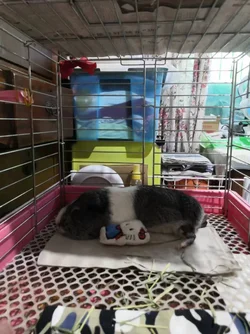
Guinea pig, female, five years and three months old
On 7 May, she developed a tilted head and loss of appetite. She was diagnosed with otitis interna at the hospital and treated with Baytril for 10 days, but it was ineffective. She then developed meningitis, seizures, and nystagmus. She was injected with sulfamethoxazole for seven days, which stabilised her condition, but she still had no appetite and did not eat much grass, although she could eat grain.
On 7 June, she stopped eating grains and hay. She was taken to the hospital for another X-ray, which showed that the inner ear inflammation persisted, causing loss of appetite. It was also suggested that her teeth might be growing, but an oral examination required anaesthesia. I requested a biochemical test, but the doctor feared she might struggle and experience stress, given her poor condition and the fact that the inner ear inflammation was incurable. The doctor recommended euthanasia and prescribed Maboxetine for home use. However, the side effects were severe, so the medication was discontinued. The rabbit still refused to eat and experienced ear pain. Sulfonamide 480 was administered for six days, which seemed to have some effect, as the rabbit showed a slight increase in appetite.
On 17 June, due to eating too much vegetables, severe bloating occurred. Treatment for bloating was administered. By the 20th, sudden swallowing and chewing difficulties arose, and even water could not be swallowed. I researched online and suspected a vitamin C deficiency, so I administered half a tablet of human-grade vitamin C. After several days of administration, by the 28th, the bloating had subsided, appetite had returned, and the animal could eat grass again.
On 9 July, after eating corn leaves, bloating resumed. Taking bloating medication provided some relief, but symptoms returned upon discontinuation. Daily bloating persisted, with each episode preventing defecation; any stool expelled was small and pointed. Currently unable to consume any vegetables.
On 30 July, I suddenly noticed that he couldn't eat grass again. He had an appetite but couldn't chew. I suspected another vitamin C deficiency and gave him human vitamin C again, previously administered as 0.5ml of liquid vitamin C.
On 31 July, I took him to the hospital. The doctor examined his mouth, ears, biochemistry, liver damage, and heart enlargement. On the day of the hospital visit, he had no bloating and defecated smoothly. The doctor did not order an X-ray. At the time, I requested an X-ray, but the doctor said that X-rays of the ears are not accurate. They examined the ears with an otoscope and then used the otoscope to examine the mouth. To examine the deeper parts of the mouth, anaesthesia is required, so they could only examine the superficial parts of the mouth. They said the teeth are currently fine, but the liver damage is quite severe, and there is still chronic inflammation in the body. The doctor didn’t have any good solutions and said that even with medication, it won’t recover. They prescribed two boxes of supplements.
Every day, he endures the pain, which is very pitiful.